The Shift from Transactional to Community-Led Fundraising: A UK Sector Blueprint
Community-Led Fundraising Models That Transformed the UK Third Sector
Rising acquisition costs and persistent donor fatigue have made conventional direct-response channels increasingly difficult for UK charities. Rather than relying on cold solicitations, organizations such as Big Give, The King’s Trust, and Macmillan Cancer Support have rebuilt their fundraising around community networks, turning donors, beneficiaries, and local organizers into active participants in their campaigns.
The Strategic Transition from Transactional Giving to Community Ecosystems
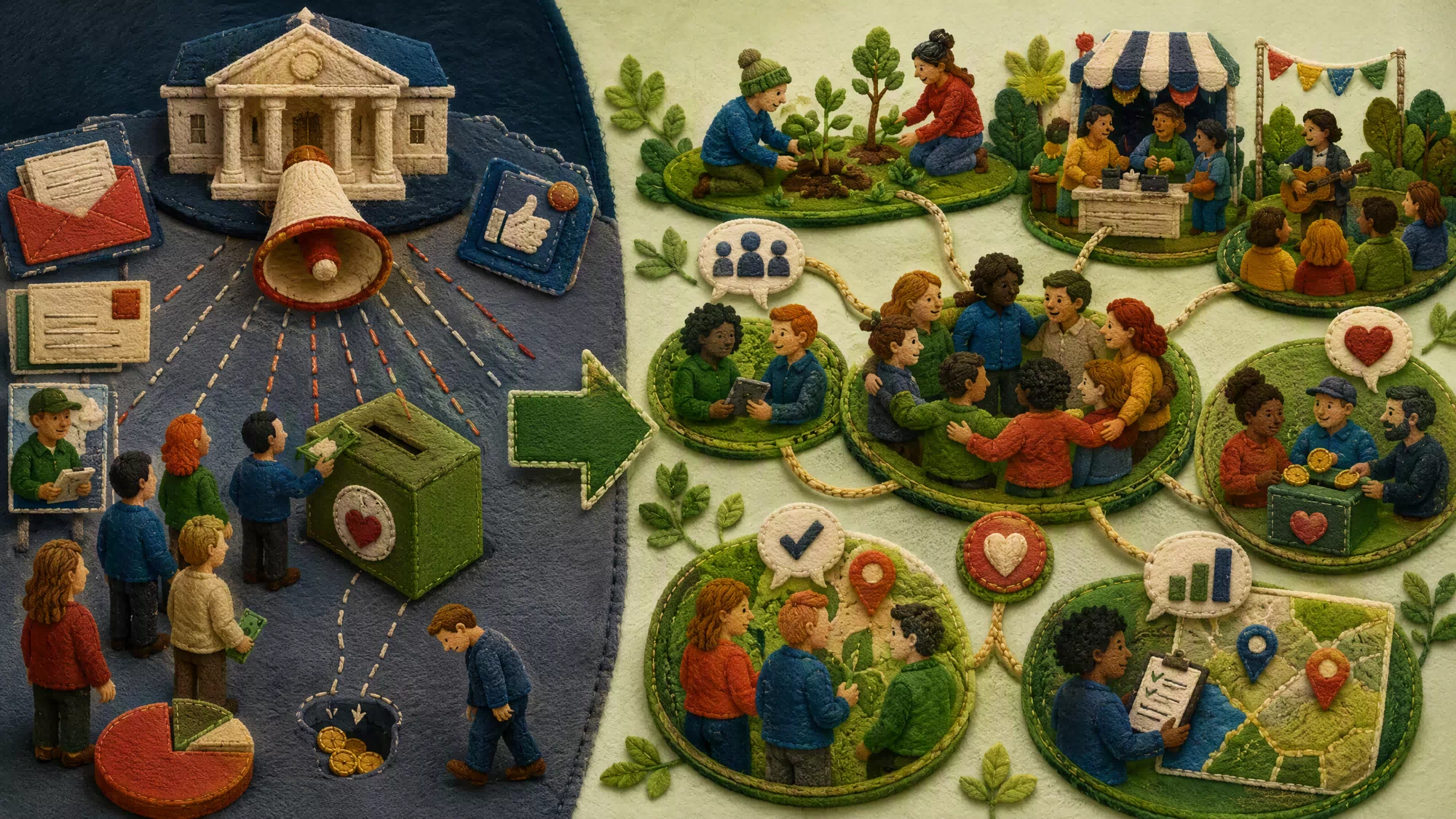
Traditional broadcast fundraising relies on volume, buying donor attention through direct mail, street canvassing, or paid social ads to secure single contributions. That transactional loop produces steep churn, with UK sector benchmarks consistently showing first-year retention rates below thirty percent for one-off cash givers. As acquisition costs climb, organizations that depend strictly on top-down appeals face diminishing net income from each new cohort.
Community-centric ecosystems change these underlying economics by decentralizing supporter engagement. Building participatory networks where contributors interact directly around shared civic or cultural goals replaces centralized appeal letters with peer validation, collaborative projects, and localized accountability.
This operational model stabilizes donor lifetime value through three measurable mechanisms:
- Peer distribution: Existing advocates recruit their personal circles, bringing paid acquisition costs down close to zero.
- Repeat involvement: Donors who participate in local events or collective match-funding campaigns renew at significantly higher rates than isolated digital donors.
- Direct operational feedback: Local organizers report regional priorities quickly, allowing teams to deploy targeted appeals that address verified community needs.
Big Give: Scaling Collective Impact with Match-Funding Architecture
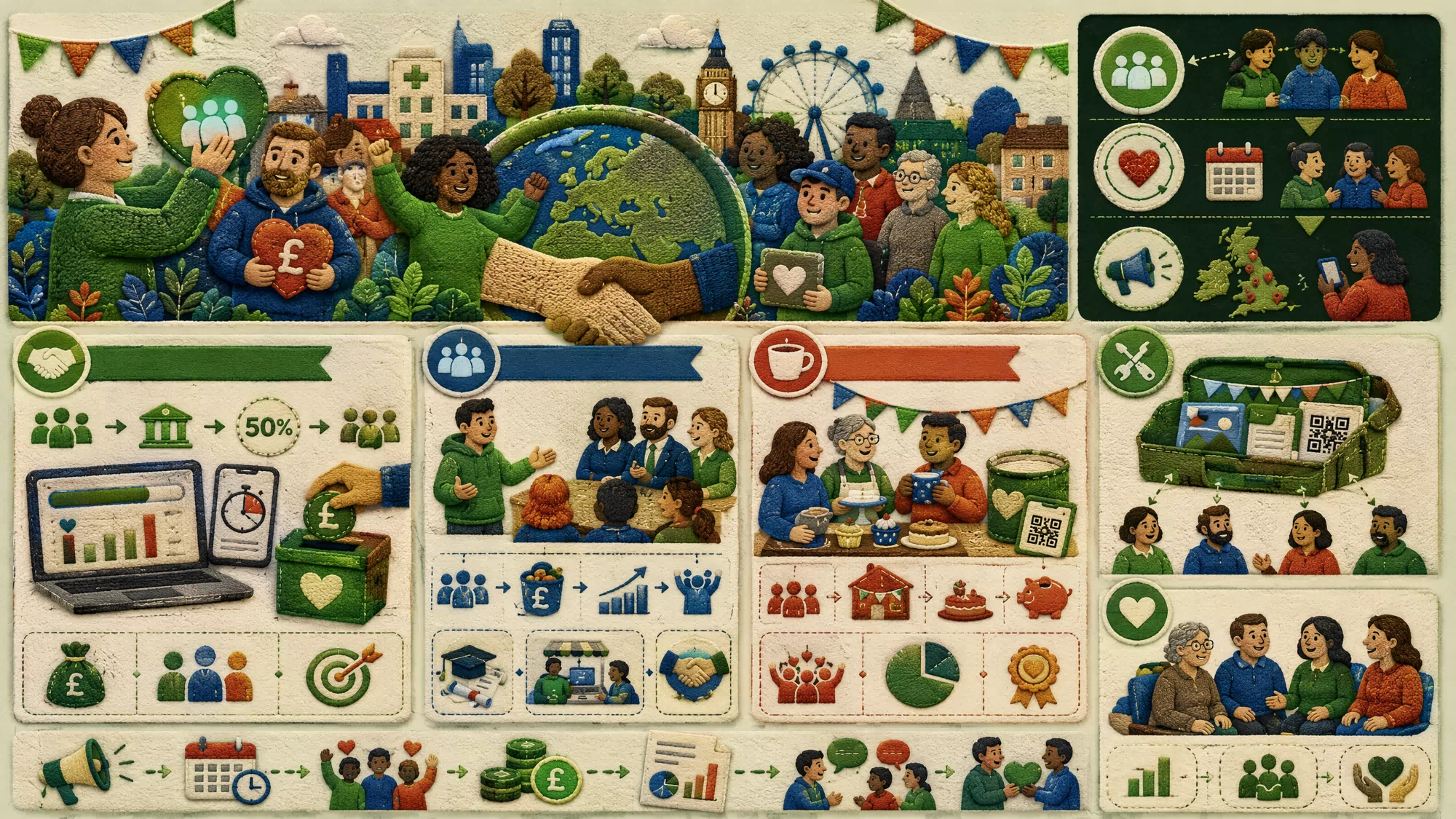
Big Give structures its match-funding campaigns to resolve a core coordination problem across the UK voluntary sector. Major philanthropic foundations (Champions) often struggle to deploy capital efficiently to smaller non-profits without running into heavy vetting and administrative overheads. Meanwhile, grassroots charities find it hard to convert one-off retail donors without a clear, time-sensitive incentive. Big Give addresses this bottleneck through a centralized 1:1 match model that brings together institutional funders, local charities, and the public within a seven-day campaign window.
Under this model, participating charities first secure twenty-five percent of their total target in pledges from board members or major donors. Big Give matches those commitments by pairing each charity with an institutional Champion, such as The Reed Foundation, who contributes an equivalent twenty-five percent allocation. This combined fifty-percent match pot is ring-fenced specifically for that individual charity rather than pooled into a shared, first-come-first-served fund. When the public window opens, every retail contribution unlocks matching funds pound for pound in real time.
Transparent software mechanics maintain that momentum throughout the campaign. Donors see live progress bars and thirty-minute checkout timers that hold matching allocations while payment details are entered. Because the match pot is guaranteed upfront, small organizations can market high-impact matching offers to their local lists without taking on financial risk. The platform also automates Gift Aid declarations and passes opted-in donor contact data directly back to the participating non-profits. During the 2023 Christmas Challenge, this architecture raised thirty-three million pounds across 1,021 UK charities, with seventy-nine percent of participants reaching or exceeding their financial targets.
The King’s Trust: Driving Peer Support and Alumni-Led Mobilization
The King’s Trust organizes beneficiary involvement around structured peer leadership rather than conventional case-study marketing. Standard youth charity appeals often treat participants as passive subjects, featuring them briefly in direct-mail appeals or annual reviews. The King’s Trust reversed that dynamic through its Young Ambassadors programme and regional alumni networks. By providing accredited training in public speaking, media relations, and advocacy, the charity equips graduates to represent the organization across commercial pitches, policy panels, and grassroots community initiatives.
Young people completing enterprise or employment programmes step directly into active ambassador roles. They give peer presentations in schools, mentor incoming cohorts, and present to corporate boards. Crucially, these ambassadors also run local outreach sessions that reach at-risk young people whom conventional broadcast marketing often misses. This direct involvement reshapes institutional fundraising. When prospective corporate partners or grantmakers assess multi-year commitments, they review proposals alongside founders who launched commercial enterprises with Trust support. Lived experience replaces top-down development copy, evidencing social return on investment through clear commercial milestones.
The Trust embeds this alumni network directly into corporate challenges, most visibly in the Million Makers competition. Corporate employee teams receive 1,500 pounds in seed funding to create mini-enterprises tasked with raising at least 10,000 pounds over six months. Young Ambassadors participate throughout the challenge, sitting on judging panels and briefing corporate teams on the direct impact of the funds raised. Since its inception, this peer-driven framework has raised over eighty million pounds, placing former beneficiaries at the center of corporate partner acquisition and long-term retention.
Macmillan Cancer Support: Decentralizing Revenue via Grassroots Social Networks
Macmillan Cancer Support set the standard for decentralized peer fundraising with its World’s Biggest Coffee Morning. First launched in 1990 as a gathering where attendees donated the cost of their coffee, the campaign grew into a nationwide institution that has raised over three hundred million pounds. Macmillan achieved this scale by turning an ordinary social ritual into a self-organizing fundraising vehicle.
Instead of booking venues or dictating rigid formats, Macmillan ships physical and digital event packs directly to volunteer hosts. Each kit contains collection boxes, bunting, promotional posters, recipe guides, and custom QR codes linked to automated donation pages. Hosts keep total control over how, where, and when they participate. Workplaces run bake sales during morning meetings, community centers set up afternoon teas, and neighborhood groups host weekend get-togethers.
This autonomy eliminates venue hire costs and heavy staffing overheads. Because the format relies on hosts inviting friends, colleagues, and family, acquisition spreads naturally through trusted personal networks. Macmillan backs these organizers with automated email sequences that provide practical hosting advice, Gift Aid collection instructions, and regional impact updates.
The system succeeds on low friction. By embedding charitable contributions into everyday social habits, Macmillan removes the athletic preparation or steep financial commitments common to marathons and gala dinners. In peak years, more than two hundred thousand individual hosts register across the country, bringing in twenty-seven million pounds in a single autumn campaign. Over seventy percent of participating organizers repeat their events annually, securing an enduring stream of unrestricted revenue.

Strategic Lessons for Modern Fundraising Architecture
The operational models of Big Give, The King’s Trust, and Macmillan demonstrate that sustainable non-profit revenue relies on participatory systems rather than expanding advertising budgets. By decentralizing campaign delivery and pairing institutional capital with grassroots energy, organizations convert passive donors into active networks. Translating these results into standard fundraising practice comes down to two structural frameworks.
Aligning Funder Incentives with Time-Bound Collective Milestones
Open-ended appeals generate low conversion rates because prospective supporters tend to defer giving indefinitely. Structuring campaigns around strict, time-boxed windows (typically spanning seventy-two hours to seven days) backed by secured match pots prompts immediate action.
Pre-committing major gifts, corporate pledges, or trust grants into a dedicated matching pool doubles individual contributions instantly. This shifts giving from an isolated cash transaction into a collective effort to unlock restricted institutional funds. A hard deadline creates genuine urgency, while live progress bars and countdown timers sustain momentum from start to finish.
For institutional funders and philanthropists, this architecture provides a transparent multiplier on their capital. Instead of quietly offsetting administrative overhead, their grants directly activate thousands of retail micro-donations, establishing shared accountability across the charity, major backers, and the wider community.

Equipping Local Organizers with Autonomy and Campaign Toolkits
Scaling community-led fundraising requires headquarters to trade micromanagement for volunteer enablement. Centralized approval processes create operational bottlenecks that slow regional activity and disempower grassroots organizers.
Instead of prescribing rigid event scripts, effective charities equip local leaders with practical self-service toolkits. These packages include customizable digital graphics, pre-written social copy, press release templates, QR-coded donation pages, and clear compliance guidelines for cash handling. With these assets in place, organizers have the freedom to adapt the format to their specific workplace, school, or neighborhood setting.
The central fundraising team then functions as a support hub rather than an administrative gatekeeper. By tracking incoming host registrations, offering direct assistance for complex queries, and sending automated milestone notifications, organizations maintain baseline quality control while supporters take genuine ownership of local fundraising results.
Sustaining Donor Retention Through Deep Community Integration
Treating supporters strictly as database records accelerates churn, forcing development teams to buy replacement donors every cycle. Long-term retention happens when contributors, volunteer hosts, and beneficiaries form an active, self-reinforcing network around an organization’s mission.
Maintaining momentum after each campaign requires clear impact reporting and direct peer touchpoints. Non-profits can publish verified project delivery metrics, host regional feedback sessions with organizers, and invite veteran event hosts to mentor new volunteers before subsequent appeals. When supporters see their micro-donations matched by institutional champions and recognized by their immediate peers, giving becomes an ongoing civic habit. That community infrastructure protects annual budgets against channel fatigue, securing predictable, unrestricted income without inflating paid acquisition costs.
Frequently Asked Questions
What is community-led fundraising?
A community-led fundraising model is a strategy where charities decentralize engagement by turning donors and beneficiaries into active participants rather than passive recipients. It replaces traditional top-down solicitations with peer networks, local accountability, and collaborative projects, which helps stabilize donor lifetime value and reduces the organization’s reliance on expensive, high-churn paid acquisition channels.
How does the Big Give match-funding model work?
The Big Give utilizes a 1:1 match-funding structure where charities secure twenty-five percent of their target from major donors, which is then matched by an institutional Champion funder. During a specific seven-day campaign window, every retail donation made by the public is doubled in real-time, effectively unlocking the combined pool of pledged funds for the participating non-profit.
What is the difference between transactional and community-centric fundraising?
Transactional fundraising relies on volume-based tactics like direct mail or paid ads to acquire one-off donors, often resulting in high churn and acquisition costs. In contrast, community-centric fundraising builds participatory ecosystems where contributors interact directly around shared goals, fostering peer validation and repeat involvement, which significantly increases donor retention rates over time.
How much money has the Macmillan Coffee Morning raised?
The World’s Biggest Coffee Morning by Macmillan Cancer Support has raised over three hundred million pounds since its launch in 1990. By transforming a simple social ritual into a decentralized fundraising vehicle, the campaign leverages personal networks to generate significant, recurring revenue without the high costs associated with traditional gala dinners or sponsored athletic events.
Why do traditional fundraising models struggle with donor retention?
Donor retention is often lower in traditional models because they treat supporters as passive database records rather than active participants. When organizations rely on top-down appeals and cold solicitations, they fail to create meaningful connections or community ownership, leading to high churn rates where first-year retention for one-off cash givers often drops below thirty percent.
How can charities scale community-led fundraising efforts?
Non-profits can scale community-led fundraising by trading micromanagement for volunteer enablement. Instead of prescribing rigid rules, organizations should provide local organizers with self-service toolkits containing customizable graphics, social copy, and compliance guidelines. This approach allows volunteers to adapt fundraising activities to their specific environments while the central team focuses on support, tracking, and maintaining baseline quality control.
Why are time-bound campaigns effective for fundraising?
Time-bound campaigns generate higher conversion rates because they create artificial scarcity and immediate urgency, preventing supporters from deferring their donations indefinitely. By structuring appeals around a strict window, such as seventy-two hours or seven days, and pairing them with secured match pots, organizations motivate donors to act quickly to ensure their contributions count toward a collective milestone.
What is The King’s Trust Young Ambassadors programme?
The Young Ambassadors programme is a peer-leadership initiative by The King’s Trust that trains former beneficiaries to represent the charity in commercial pitches, policy panels, and community outreach. By equipping young people with public speaking and advocacy skills, the organization replaces top-down marketing with lived experience, proving social impact to corporate partners while empowering the beneficiaries themselves.
