Implementing Digital Charity Trends for 2026 UK Nonprofits
The United Kingdom charity sector enters 2026 facing a pronounced digital paradox. Recent sector data reveals that while 76% of UK charities are actively using or experimenting with artificial intelligence, only 44% possess a formal digital strategy. This strategic gap exposes organisations to operational fragmentation, governance risks, and inefficient resource allocation. The pressure to modernise is intensified by a persistent digital divide, where smaller regional charities in Northern England, the Midlands, and Northern Ireland struggle with lower digital maturity and restricted access to dedicated funding.
To thrive in this environment, charity leaders must transition from tactical, ad-hoc tool adoption to structured digital charity transformation. This shift requires aligning technological investments directly with measurable donor engagement and operational efficiency. The digital charity trends defining 2026 focus on using targeted nonprofit technology to build deeper trust, simplify the giving experience, and demonstrate tangible social impact in real time. Success requires aligning software investments with actual donor behaviors and regional operational capacities.
Hyper-Personalised Donor Journeys through Predictive Data
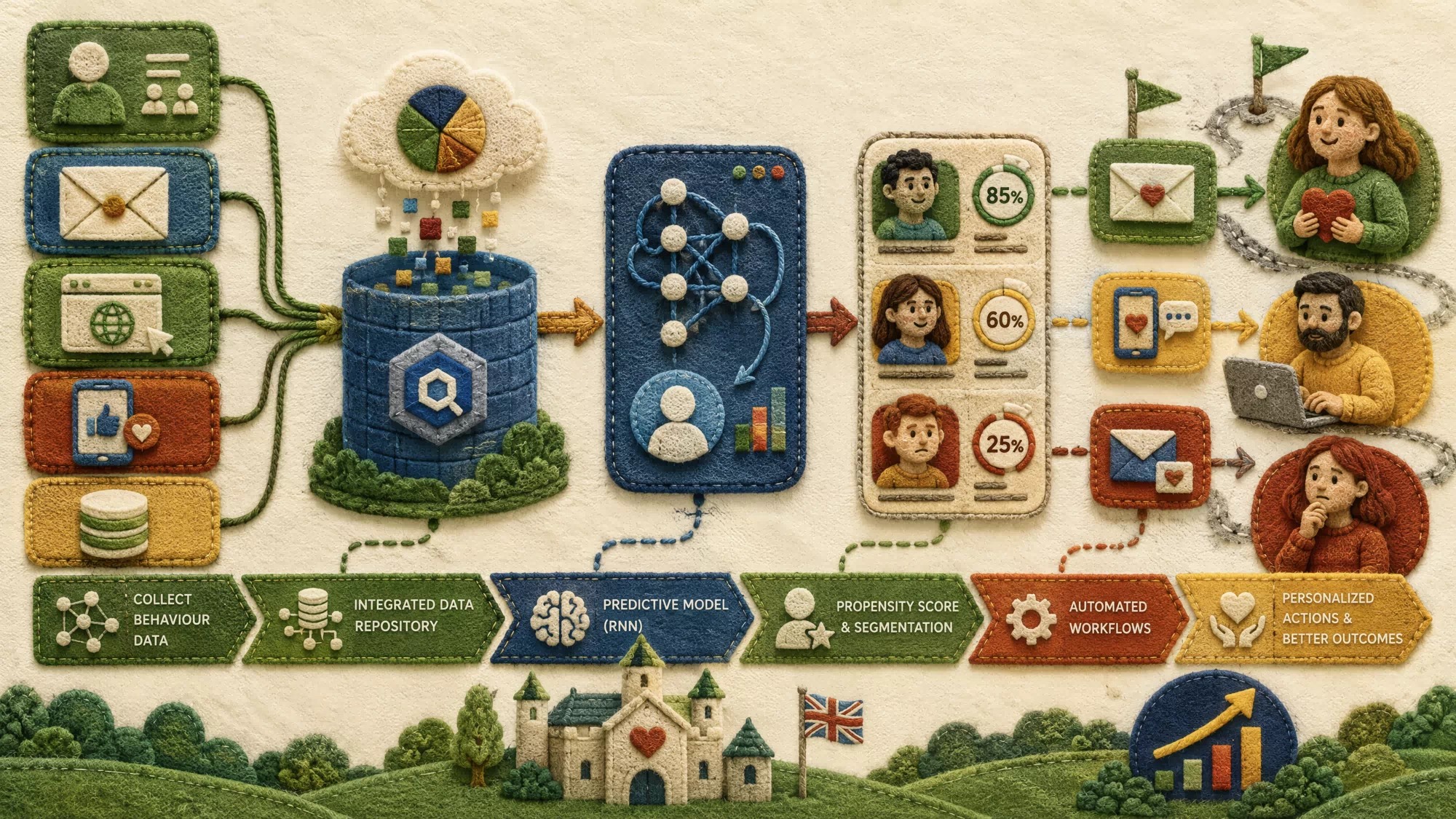
Traditional donor segmentation based on postcode demographics or basic Recency, Frequency, Monetary (RFM) metrics is being replaced by predictive analytics and machine learning. UK nonprofits are shifting toward behaviour-based pathways that anticipate donor intent and automate outreach timing. By analysing sequential interactions, organisations can predict when a donor is primed to give, when they are at risk of lapsing, and what specific content will encourage their next contribution.
Research in predictive modeling shows that Recurrent Neural Networks (RNNs) can analyze a supporter’s last five digital actions, including email opens, campaign page visits, and social media clicks, to predict their next donation amount with high accuracy. Once trained, these models identify the optimal next action for each supporter, moving them along a highly tailored journey. For instance, Prostate Cancer UK has utilised machine learning to assign a predictive propensity score to individual donors. This score indicates the probability of a donor responding to an upcoming appeal, allowing the fundraising team to target communications precisely and avoid donor fatigue.
Implementing this predictive approach requires a clean, integrated data infrastructure. Charities must consolidate data from disparate customer relationship management (CRM) systems, email marketing platforms, and web analytics into a centralized data repository, such as Google BigQuery. This consolidated data feeds the statistical models that generate propensity scores and trigger automated workflows. By centering donor relations on empirical behavioral predictions, UK charities can significantly increase retention rates while lowering acquisition costs.
Frictionless Giving and the Rise of Open Banking
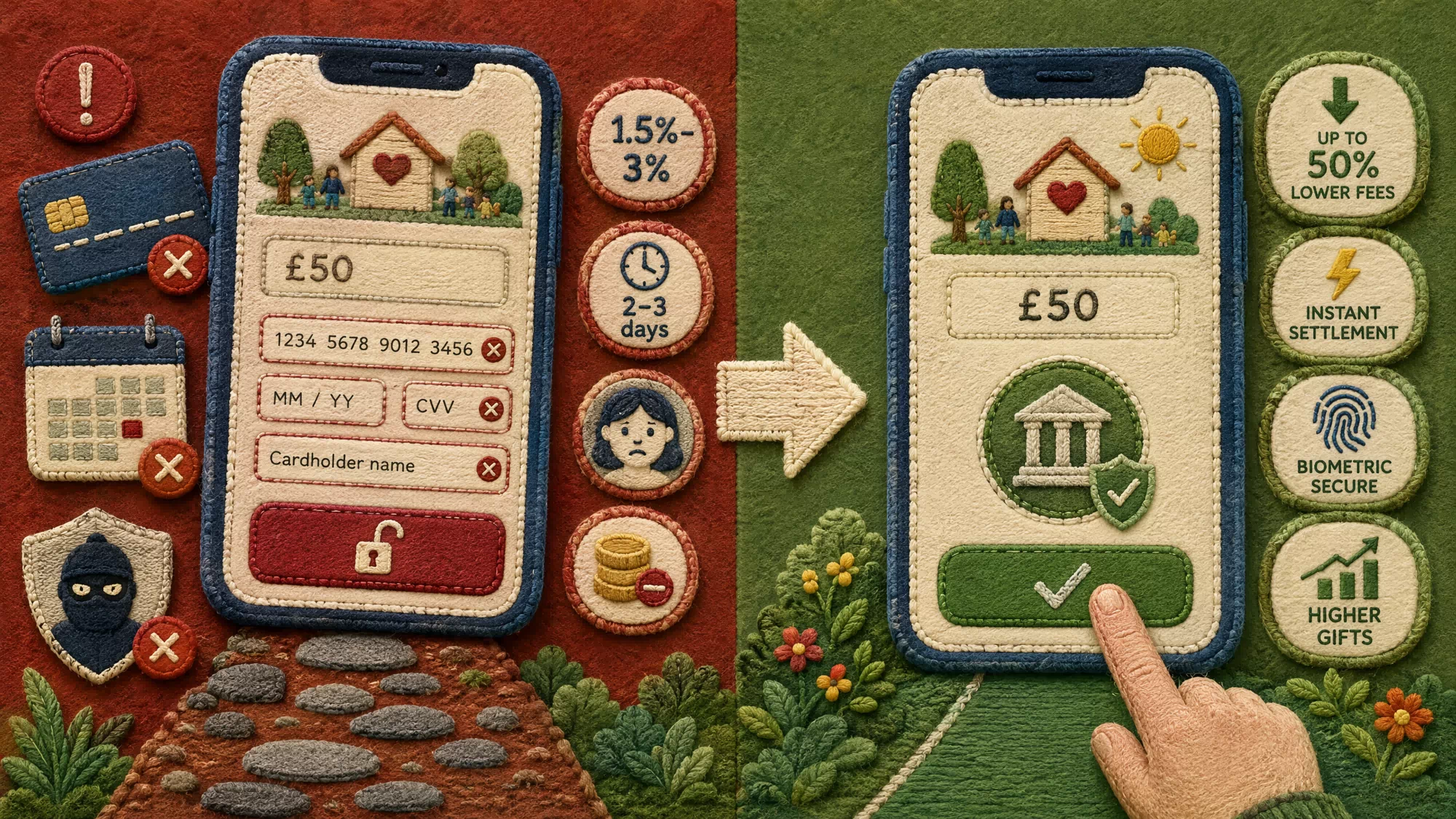
Donors increasingly expect the checkout experience of modern e-commerce when supporting their chosen causes. Traditional card payments often introduce friction through manual entry, expired cards, and high transaction fees that eat into charity revenues. To solve this, UK charities are adopting Open Banking, which enables secure, direct account-to-account payments without intermediaries.
This technology bypasses card networks entirely, allowing supporters to authorize donations directly from their banking apps. The financial impact is immediate. While standard credit card processing fees typically range from 1.5% to 3%, Open Banking transactions processed through specialized platforms can reduce these costs by up to 50%. For larger gifts, this difference translates to thousands of pounds redirected from payment processors to front-line services.
| Feature | Traditional Card Payments | Open Banking (Account-to-Account) |
| Transaction Fees | 1.5% to 3.0% per transaction | Lower processing costs |
| Settlement Speed | 2 to 3 business days | Instant settlement via Faster Payments |
| Donor Security | High risk of card fraud and manual entry errors | Biometric authorization via native banking apps |
| Average Gift Size | Moderate, often limited by card limits | Significantly higher, particularly for major donors |
Major UK platforms have already integrated these systems to support charity digital transformation. For example, JustGiving partnered with GoCardless to introduce Instant Bank Pay and direct bank transfers, capturing a significant portion of their donation volume. Similarly, the Catholic Agency for Overseas Development (CAFOD) integrated Open Banking through the Wonderful platform, facilitating fee-free donations where the full amount reaches the designated project.
From a donor perspective, Open Banking eliminates the need to input 16-digit card numbers, expiry dates, or CVV codes. This reduction in steps helps decrease checkout abandonment rates by up to 30% during mobile donation journeys. Furthermore, modern nonprofit technology allows charities to link Open Banking flows directly with automated Gift Aid declarations, ensuring that the additional 25% tax relief is claimed instantly without requiring separate paperwork.
To implement this technology, charity managers must evaluate their existing donation portals. Integrating an Open Banking API requires selecting an authorized payment initiation service provider (PISP) regulated by the Financial Conduct Authority (FCA). This setup ensures compliance with payment services regulations while providing a secure pathway for donors to complete transactions in under three clicks.
Community-Led Fundraising and Creator Partnerships
Decentralized, community-led fundraising is replacing the traditional reliance on high-profile celebrity ambassadors. In the UK, this shift is driven by digital-native creators on platforms such as Twitch, YouTube, and TikTok, who mobilize their existing audiences to support specific campaigns. This approach relies on deep community engagement rather than broad, passive awareness.
Creator-led campaigns utilize specialized nonprofit technology like Tiltify to integrate live fundraising tools directly into digital broadcasts. These integrations enable real-time donation alerts, interactive milestones, and gamified incentives, turning giving into a collective social event. For example, creators can set specific donation targets that trigger interactive events, such as extending a live stream or participating in a community challenge once a funding goal is met.
The scale of this fundraising method is demonstrated by Jingle Jam, a major UK creator-led gaming charity event. The December 2024 Jingle Jam event raised £2,673,841 for eight charity partners, including Autistica and the Campaign Against Living Miserably (CALM). The December 2025 event set a new record by raising £3.23 million, pushing the project’s lifetime fundraising total past £30.7 million.
For UK charities, succeeding in this space requires moving beyond transactional one-off requests. Organizations must build long-term relationships with creators whose values align with their mission. CALM has demonstrated this by establishing multi-year partnerships with gaming creators and hiring dedicated digital community managers to oversee these relationships. This strategy ensures that the charity remains a consistent part of the creator’s community conversations rather than an occasional mention.
When planning these partnerships, charity managers must provide creators with creative autonomy. Creators understand their audiences better than any external marketing team, and forced scripts often alienate viewers. Instead, charities should provide raw assets, impact data, and clear compliance guidelines, allowing the creator to weave the cause naturally into their content. This ensures the campaign remains authentic while meeting UK fundraising regulator standards.
Ethical AI Integration in Charity Digital Transformation
UK charities are adopting artificial intelligence rapidly, but the focus in 2026 is moving from raw capability to strict ethical governance. Ad-hoc adoption of generative tools without clear guardrails introduces severe compliance risks, particularly regarding data privacy and algorithmic bias. To address this, the Charity AI Task Force, launched in early 2025 by CAST and Zoe Amar Digital, advocates for structured, responsible AI deployment that prioritizes beneficiary safety and data sovereignty.
Implementing ethical AI within your charity digital transformation strategy requires a formal, trustee-approved policy. This policy must define permitted use cases, mandate Data Protection Impact Assessments (DPIAs) for high-risk applications, and establish clear guidelines for processing beneficiary data. For organizations aligning with international standards, the upcoming August 2026 compliance milestones of the EU AI Act provide a useful framework for managing risk in automated service delivery.
Human oversight is the non-negotiable core of this transition. While machine learning models excel at summarizing volunteer applications or analyzing donor trends, human staff must retain final authority over service delivery decisions and programmatic outcomes. Your policy should explicitly prohibit automated decision-making in sensitive areas, ensuring technology assists rather than replaces human empathy.
Real-Time Impact Transparency through Modern Nonprofit Technology
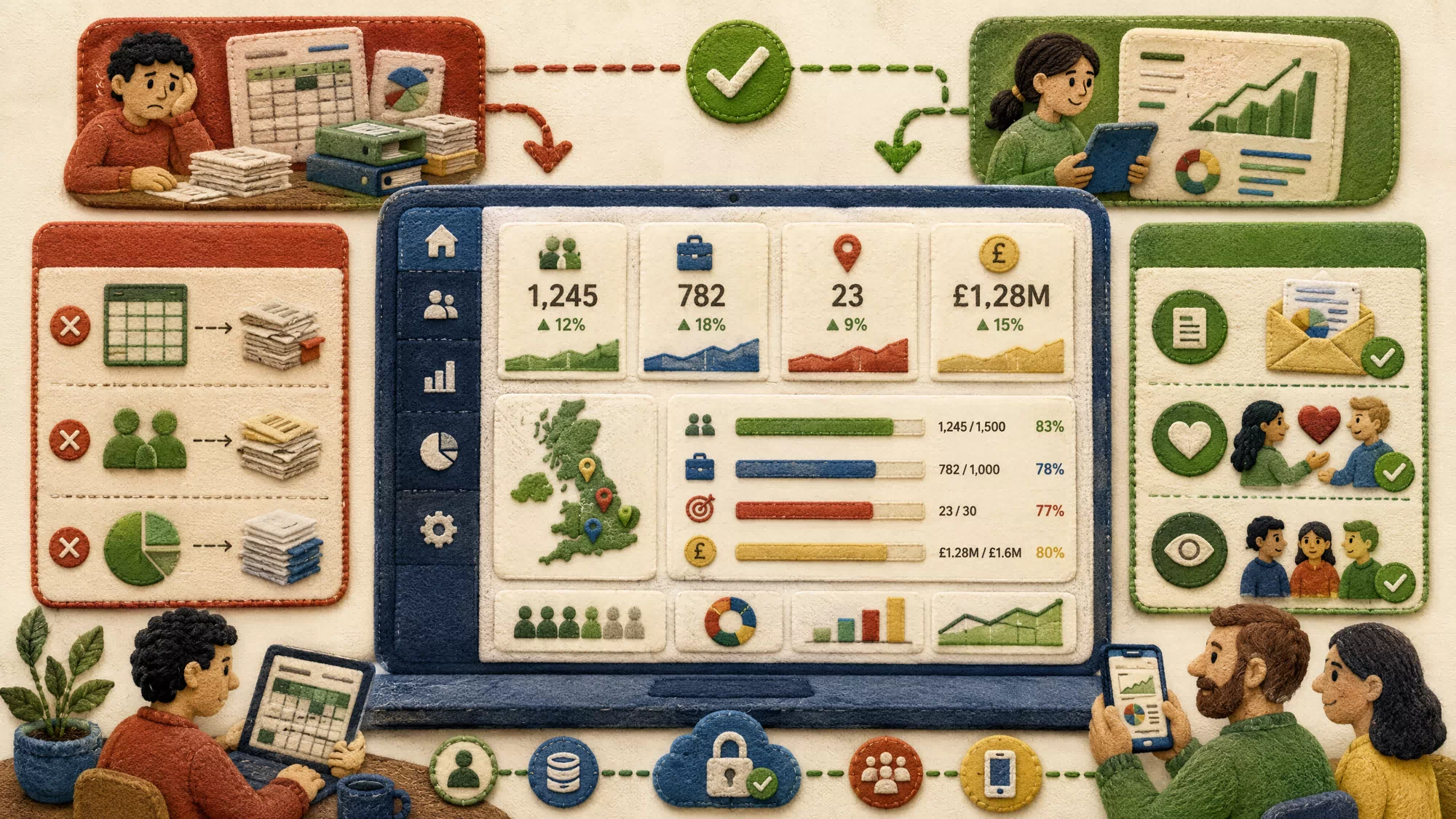
Modern donors and institutional funders no longer want to wait twelve months for an annual report to see how their contributions were spent. The demand for immediate accountability is driving a shift toward real-time impact transparency, powered by integrated nonprofit technology. By connecting casework database systems directly to public-facing dashboards, organizations can display progress and outcomes as they happen.
The UK sport-for-employment charity Street League pioneered this trend by launching an interactive online dashboard that updates key outcomes monthly. Instead of presenting curated success stories once a year, the charity provides continuous, unfiltered access to regional employment statistics and participant progress.
Achieving this level of transparency requires moving away from manual spreadsheets to unified platforms such as Plinth or Makerble. These tools integrate day-to-day case management with live reporting features. When front-line staff record service delivery, the system automatically updates the public or funder-facing KPIs.
Transitioning to real-time reporting provides two main operational advantages:
- Funder reporting automation: Platforms like Plinth use integrated data to auto-generate customized progress reports, reducing administrative hours spent on manual collation.
- Continuous donor validation: Giving pages linked directly to live project trackers allow supporters to see their funds deployed on the ground immediately, which increases second-gift retention rates.
To align with key digital charity trends for 2026 UK nonprofits, charity managers must audit their existing data collection points. Your goal is to establish a direct pipeline from front-line activity to your reporting dashboard, ensuring that data protection protocols remain intact while making impact metrics immediately visible to stakeholders.
Strategic Imperatives for UK Charity Leaders
To capitalise on the digital charity trends for 2026 UK, executives and trustees must move from passive observation to active governance. The gap between adopting modern nonprofit technology and having a cohesive strategy can only be closed by making digital capability a core board-level priority.
First, audit your existing systems to identify where integration gaps exist. Many organisations run siloed platforms that prevent predictive data modeling or real-time impact reporting. Prioritise API-first software that allows different platforms to communicate without custom, expensive middleware.
Second, allocate budget specifically for digital upskilling rather than just software licences. Technology is only as effective as the team operating it. Investing in training ensures your staff can confidently manage Open Banking integrations, creator partnerships, and ethical AI protocols.
Finally, establish a digital ethics framework that guides how your charity digital transformation respects donor privacy and beneficiary safety. By balancing technical innovation with strict operational guardrails, your organisation secures the exact data compliance and donor trust needed to sustain modern UK fundraising campaigns.
FAQ
What is Open Banking and why should UK charities use it?
Open Banking is a secure technology that allows donors to make direct account-to-account payments via their banking apps, bypassing traditional card networks. UK charities benefit by reducing transaction fees by up to 50 percent, receiving funds instantly, and lowering checkout abandonment rates. By removing the need for manual card entry, this method offers a faster, more secure, and cost-effective way to process donations.
How can UK charities use predictive analytics to improve donor retention?
Charities can use predictive modeling to analyze past donor behavior, such as email opens and donation history, to determine the optimal time and content for future appeals. By assigning a propensity score to each supporter, organizations can automate personalized communication pathways. This data-driven approach helps target donors when they are most likely to give, ultimately increasing retention rates while reducing overall acquisition costs.
What is the difference between traditional fundraising and creator-led campaigns?
Traditional fundraising often relies on broad, passive awareness campaigns and celebrity ambassadors to reach mass audiences. In contrast, creator-led fundraising leverages digital-native influencers on platforms like Twitch and TikTok to mobilize their specific, engaged communities. These campaigns use integrated nonprofit technology to offer real-time donation alerts, gamified milestones, and interactive experiences, turning the act of giving into a collective, social event.
How do charities demonstrate real-time impact to their donors?
Charities demonstrate real-time impact by integrating front-line casework databases directly with public-facing dashboards. Instead of waiting for annual reports, organizations use platforms that automatically update project progress and outcome metrics as staff record service delivery. This transparency allows donors to see exactly how their contributions are being used, which fosters trust and encourages repeat giving by providing continuous, verifiable validation of the charity’s work.
What steps should UK charities take to implement ethical AI?
To implement ethical AI, charities must establish a trustee-approved policy that defines permitted use cases and mandates Data Protection Impact Assessments for high-risk applications. Organizations should prioritize human oversight, ensuring that staff retain final authority over service delivery and programmatic decisions. Adopting these guardrails helps manage compliance risks, protects beneficiary data, and ensures that technology supports rather than replaces human empathy in charity operations.
How much can charities save on transaction fees using Open Banking?
Charities can save significantly on transaction fees by switching to Open Banking, which often reduces processing costs by up to 50 percent compared to standard credit card payments. While traditional card transactions typically incur fees ranging from 1.5 percent to 3 percent, Open Banking bypasses intermediaries entirely. These savings allow charities to redirect thousands of pounds directly toward their front-line services and mission-critical projects.
