Strategic Donor Retention: Moving Beyond Fatigue to Sustainable Giving in 2026
Acquiring a new donor costs far more than keeping one you already have, yet most nonprofits still pour their energy into recruitment while retention quietly leaks revenue out the back door. Chasing new names fills the funnel for a quarter, but it does nothing for the organization’s long-term stability. That stability comes from something less glamorous: a real system for keeping the people who already believe in you.
In 2026, the nonprofits that pull ahead won’t be the ones with the flashiest acquisition campaigns. They’ll be the ones that stopped treating the first gift as the finish line and started treating it as the beginning of a relationship, one built on honest communication, visible impact, and genuine respect for what a donor has already given. Get that right, and the constant, expensive scramble for new supporters becomes far less necessary.
This guide looks at why donor fatigue happens, and what it actually takes to build a base of supporters who stick around.
The Reality of Donor Fatigue in Modern Nonprofit Fundraising
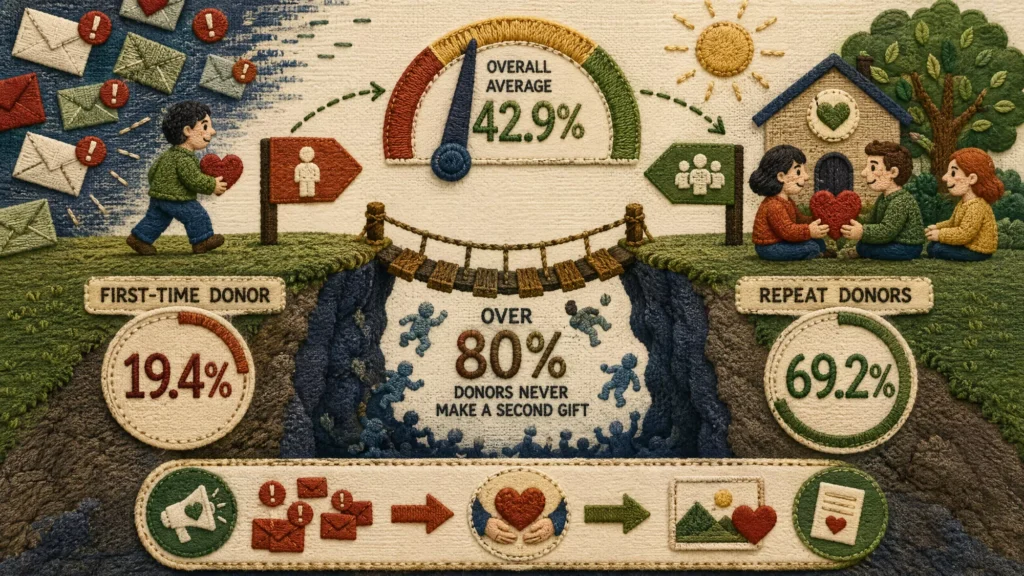
Donor fatigue isn’t mysterious. It’s what happens when people get asked for money over and over, from every direction, without ever hearing what their last gift accomplished. Eventually they tune out.
The numbers back this up. According to the Fundraising Effectiveness Project, overall donor retention across the sector sat at 42.9% in 2024, and for first-time donors, it was just 19.4%. Put plainly: more than four out of five people who give once never give again.
| Donor Segment | Retention Rate |
| First-Time Donors | 19.4% |
| Repeat Donors | 69.2% |
| Overall Average | 42.9% |
Notice the jump between those two rows. Once someone makes it to a second or third gift, their odds of sticking around nearly quadruple. That first-to-second-gift window is where organizations lose the most ground, and where fixing the problem pays off the most.
Part of the issue is habit. Many nonprofits only reach out when they need something, which quietly turns the relationship into a transaction: you give, we go quiet, we come back asking again. Breaking that pattern means talking to donors between asks, not just during them, and showing them where their money went before assuming they’re ready to send more.
From Transactional Asks to Shared Victories: A Value-First Approach

A lot of fundraising fails for a simple reason: it puts the organization at the center of the story and the donor on the sidelines, funding from a distance. Flip that, and the ask becomes an invitation to accomplish something together.
Instead of a generic tax receipt followed by silence, organizations with strong retention build a real gratitude sequence. A conservation group, for instance, might send a short personal video within 48 hours showing the exact acreage a donor’s gift protected. No ask attached, just proof that the gift did something real.
Language matters here too. “We expanded our food distribution network” describes the organization. “Your gift provided four thousand meals this month” describes the donor’s impact. The second version puts the donor in the story as the one who made something happen, not just the one who paid for it.
A useful rule of thumb: for every fundraising appeal, send at least three messages that ask for nothing. Project updates, an invitation to a briefing with field staff, a handwritten thank-you from someone the program helped. Keep that ratio, and your organization becomes a source of good news rather than a recurring bill.
One international water charity took this further with a “proof of work” sequence: within three months of a gift, donors received GPS coordinates and photos of the actual well their money helped build. That kind of transparency addresses the real root of donor fatigue, the fear that a donation just disappears into overhead. Prove otherwise, and a one-time gift starts to feel like a shared win.
Smaller, personal touches work too. A quarterly call from a board member to a mid-level donor, with no ask attached, just a thank-you and one specific story. A short monthly email to recurring donors highlighting a single concrete result. By the time the next formal appeal lands, the donor has already seen where their money went.
Data-Driven Segmentation for Personalized Donor Engagement
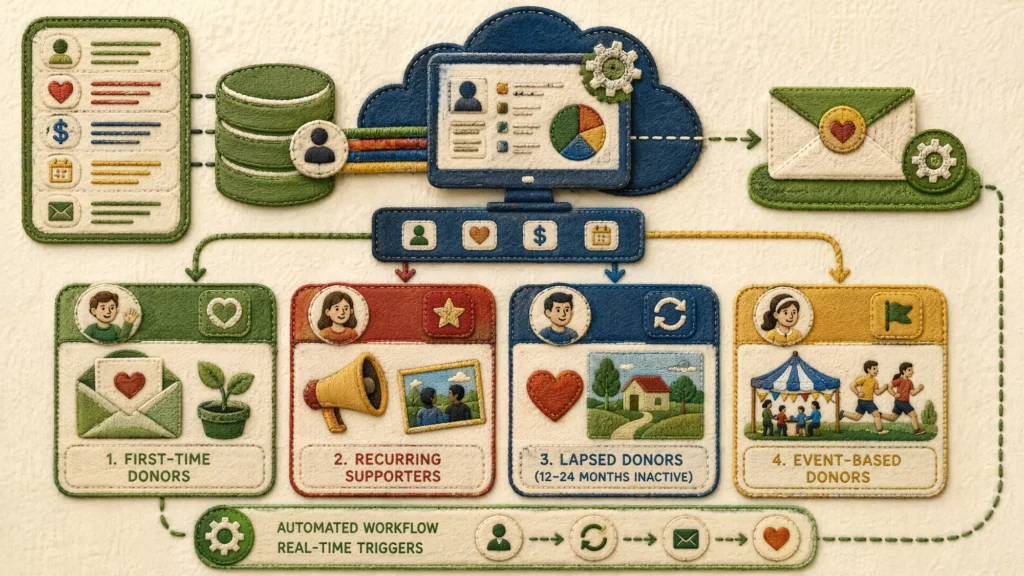
Sending the same blast email to everyone in your database is one of the fastest ways to burn people out. A $5,000 donor and a first-time $10 donor getting an identical appeal both walk away feeling unseen. Personalization starts with clean CRM data and a willingness to actually use it: grouping supporters by giving history and behavior, not just by demographics.
Four segments are worth building around:
- First-Time Donors. Give them a welcome series that explains your mission and how gifts are used, and hold off on asking for a second gift for at least ninety days. The priority here is trust, not revenue.
- Recurring Supporters. These are your most reliable people, and they deserve to be treated that way: behind-the-scenes updates, genuine appreciation, and occasional invitations to bump their monthly gift up by a small amount, never a generic “please give” appeal.
- Lapsed Donors (12 to 24 months inactive). A win-back message should acknowledge their history (“we miss your partnership”), show what their past support achieved, and only then ask them to come back.
- Event-Based Donors. People who first gave through a gala, a run, or a peer-to-peer page usually connect to the event or the participant, not your core mission yet. Follow-up should bridge that gap with stories tied to the event theme.
Doing this by hand doesn’t scale, which is where automation earns its keep. When a donor’s status flips from one-time to recurring, your CRM should move them off the general appeal list automatically. The same goes for program interest: someone who only funds your animal shelter’s medical fund doesn’t need appeals about your outreach programs. Tag them, and target accordingly. Fewer mismatched messages means fewer unsubscribes.
Operationalizing Retention with Sustainable Giving Models
Real retention isn’t a communications trick, it’s an operating system. Instead of leaning on big seasonal pushes to make up for lost donors, build recurring giving, structured stewardship, and clear paths to upgrade, and you get predictable revenue without the constant pressure to recruit.
Start with the monthly giving program itself. Don’t frame recurring donors as small-dollar givers who happen to give often. Give them an identity, a partners circle, a sustainers network, whatever fits your brand, tied to a clear promise that their support keeps the work running every month.
Remove friction wherever you can. Default donation forms to monthly giving where it makes sense, spell out what specific amounts fund, and make it painless to manage or adjust a subscription. A $25/month donor should know immediately what that buys: meals, medical supplies, tutoring hours, shelter nights, whatever ties back to your mission.
Stewardship works best when it’s built into the system rather than left to whoever remembers to send an email. Map out the donor lifecycle in advance: an immediate thank-you, a note from leadership within a week, an impact update at thirty days, a personal check-in at ninety. New supporters should land in a structured sequence, not a general mailing list.
Build in upgrade paths too. After six to twelve months of consistent giving, invite a donor to increase their gift with a specific, concrete ask: “You’re already helping provide weekly meals. $10 more a month would feed one more family.” It respects what they’ve already committed while offering something specific to grow into.
And watch for the warning signs before someone lapses entirely: failed payments, dropping email opens, skipped events, ignored impact updates. A simple retention dashboard tracking recurring donor churn, first-to-second gift conversion, and lifetime value will surface problems while there’s still time to act.
None of this works if it sits only with the development team. Program staff supply the stories and proof; communications turns that into donor-facing messaging; development manages the stewardship and the asks; leadership backs it all with visible transparency. When those pieces move together, retention stops being a side project and becomes how the organization runs.
Conclusion: Securing Long-Term Support in a Distracted World
Retention in 2026 comes down to earning attention and trust in a world full of competing causes and constant noise. Organizations that lean only on urgent appeals will keep losing donors to fatigue and unpredictable revenue. The alternative is building relationships where donors feel informed, appreciated, and connected to something real.
Donor fatigue was never really about being asked too often. It’s about being asked without context, gratitude, or proof that the last gift mattered. Show donors what they made possible before you ask again. Match your messages to who they actually are. Build recurring giving into something dependable, with donors playing a visible role in the outcome.
Every thank-you, every impact update, every renewal ask should carry the same message: the donor isn’t just funding the mission, they’re part of it. In a distracted world, that’s what loyalty is built on, one honest update at a time.
