Beyond the Donation Button: Why UK Donors Now Demand Relational Giving
Beyond the Donation Button: How Relational Giving Is Reshaping British Philanthropy
British donors increasingly treat charitable giving as an ongoing partnership. On a standard donation screen, however, submitting debit card details is often the final interaction before an automated tax receipt hits the inbox. That abrupt cut-off explains why UK charity sector reports show first-year donor churn regularly exceeding 70 percent.
Supporters want genuine operational accountability. They expect direct sightlines into funded projects, open dialogue with organisers, and independent verification of ground-level work. Sustainable fundraising models respond by maintaining active spaces that record weekly milestones, allocate volunteer tasks, and show how every pound directly alters outcomes.
The Operational Friction in Conventional Crowdfunding
Legacy crowdfunding platforms still rely on technical models designed over fifteen years ago. Built around one-way broadcasts and one-off checkout forms, these sites isolate donors from active projects. Unexpected fees, rigid payment funnels, and dormant update pages leave contributors disconnected from organisers almost immediately after giving.

Platform Fees and Donor Friction Points
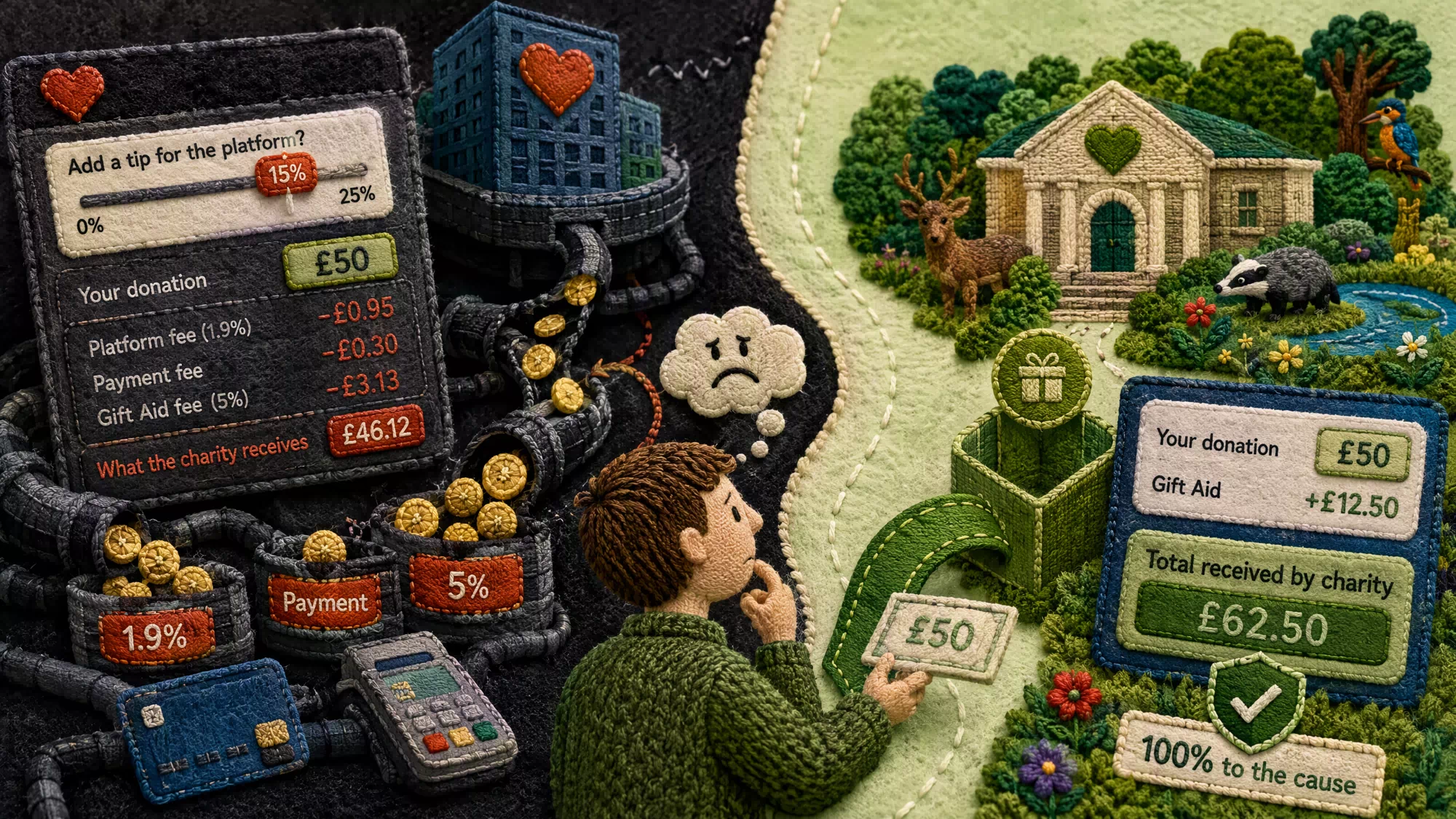
GoFundMe charges 2.9 percent plus 25p on personal appeals, dropping to 1.9 percent plus 20p for registered charities. At checkout, it inserts a pre-selected tipping slider that defaults as high as 15 percent. JustGiving takes a similar cut of 1.9 percent plus 30p, while skimming 5 percent off every Gift Aid claim processed. When a donor contributes £50 to a registered cause, the intended £62.50 total with Gift Aid never arrives intact; payment processors and platform deductions siphon off funding before work even starts.
These checkout friction points provoke immediate frustration. Someone setting out to fund a local hospice or wildlife trust suddenly faces prompts to subsidise a multi-million-pound commercial platform through manipulative interface design. British donors increasingly reject these extraction tactics. They expect direct, fee-transparent channels that pass 100 percent of Gift Aid and principal contributions straight into the recipient project’s bank account.
The Disconnect Between Payment Gateways and Realized Impact
Standard crowdfunding portals operate much like high-volume retail checkouts. The moment your debit card payment clears, the digital relationship abruptly ends. You receive an automated PDF receipt with an alphanumeric reference code, followed by complete radio silence from the organisation. If you want to confirm whether your contribution bought medical kits or paid a community centre’s heating bill, you have to manually check a static web page that the organiser has not updated in four months.
This payment-gateway setup reduces your role to an isolated ledger entry. Without interactive forums or direct communication tools, you cannot ask operational questions, inspect equipment receipts, or talk to volunteers working on the ground. When platform software treats charitable gifts purely as settled financial transfers, it severs the tie between supporter and cause. Organisers miss valuable opportunities to recruit local volunteer help or secure dependable monthly pledges. Instead, the system simply archives your details as an inert email address, paving the way for impersonal quarterly appeals that bear no relation to the tangible milestones of the project you originally backed.
Evolving Expectations Among British Donors
British donors increasingly approach charitable giving with the mindset of an active project stakeholder. You want your money tied directly to identifiable local outcomes, open field communication, and participatory community decisions. Modern civic giving demands ongoing involvement, where a financial pledge serves as an active vote of confidence in grassroots leadership.
Continuous Narrative Updates Over One-Off Receipts
When you back a flood-relief effort in Somerset or a youth kitchen in Leeds, an automated PDF receipt confirms nothing beyond payment clearance. Donors expect project organisers to publish date-stamped progress logs directly from the ground. Concrete evidence carries real weight: unedited smartphone video clips of fresh pantry deliveries, time-stamped photographs of completed roof repairs, and itemised supplier receipts uploaded as work unfolds.
Direct narrative tracking grounds each financial contribution in day-to-day operations. You see precisely when a volunteer team finishes clearing an overgrown community allotment, or when specialised medical kits clear customs at Heathrow. Public comment threads under these entries allow you to ask direct questions about volunteer hours or equipment sourcing. UK charities that publish live field updates every ten to fourteen days achieve far higher retention than groups relying on static annual PDF reports. Following each procurement decision, equipment installation, and finished delivery in your feed confirms that project expenditure strictly matches promised milestones.
Direct Community Participation and Verified Stewardship
Active British supporters treat charitable projects as spaces for practical collaboration rather than distant causes. You want direct messaging channels to question trustees and frontline directors about administrative overheads, volunteer safety protocols, or local supplier choices. When project leaders answer those inquiries in public feeds, the exchange creates an open, verifiable track record for everyone in the group, closing the gap between remote contributors and ground-level coordinators.
Peer participation turns financial giving into a working civic partnership. Inside interactive campaign groups, you can compare notes with fellow supporters in your borough, coordinate weekend volunteering shifts, and contribute professional skills alongside monetary donations. A local surveyor can inspect building foundations for a community centre refurbishment, while an accountant reviews material invoices published in the campaign thread.
Stewardship ultimately works through public scrutiny and straightforward checks. You can verify registered charity numbers directly against the Charity Commission register before transferring money. On their end, organisers post scanned receipts, planning permissions, and equipment serial numbers into active discussion feeds, allowing contributors to inspect field operations before pledging additional funds.

Dedicated Social Networks as Modern Philanthropic Hubs
Purpose-built philanthropic networks replace isolated checkout screens with persistent, ad-free civic environments. Platforms like GardenOfLove organise fundraising appeals around dedicated cause communities, known as Gardens, where registered UK charities and active supporters interact continuously. You follow distinct initiative feeds much like community groups on mainstream social networks, but without intrusive advertising, algorithmic feeds, or sponsored posts. That uncluttered setup keeps donor attention focused squarely on community welfare and verified project deliverables.
Behind the scenes, financial processing integrates directly into public social workspaces. Non-profit organisations must verify their credentials against Charity Commission records before launching appeals, filtering out anonymous solicitations from the start. Verified charities connect their own Stripe accounts directly to their organisational profiles, routing your contribution straight into the organisation’s bank account without intermediary holding accounts or delayed payout schedules. The platform charges zero commission on donations and passes 100 percent of Gift Aid to the charity, sustaining core infrastructure through optional voluntary tips. Open ledger summaries let you inspect the exact sums received by project coordinators.
Inside each Garden, fundraising appeals operate alongside volunteer rotas, supply checklists, and chronological progress diaries. When an organiser posts a video showing newly purchased commercial ovens for a food bank, you can comment directly on the post, ask about delivery dates, or offer van transport for collection. Other supporters in your area see those responses and volunteer their own time to help install the units. Backers coordinate physical site clean-ups, contribute trade skills, and track supply distribution in the exact thread where donations happen. You monitor equipment receipts, volunteer shifts, and milestone completions straight from your member dashboard, without chasing updates across external email newsletters or separate payment gateways.
Adapting Campaign Strategy for Long-Term Supporter Retention
Retaining British donors beyond a single payment cycle requires steady operational reporting. Publish unvarnished fortnightly field logs written directly by site coordinators. If an environmental charity faces delayed planting permits or unexpected nursery costs, posting the revised timeline and itemised contractor quotes straight to the project feed preserves trust. Supporters respect logistical setbacks when documented with verifiable evidence.
Anchor campaigns to measurable micro-milestones with defined targets. Allocate specific expenditure brackets to concrete deliverables, such as purchasing sixty thermal blankets or funding twenty hours of youth counselling. Once funds clear, immediately upload the corresponding supplier receipts and delivery notes to validate the outlay. British contributors renew direct debit pledges when they see precise accounting for prior spending.
Pair financial appeals with practical non-monetary requests. Invite local contributors to audit facility energy tariffs, arrange van haulage, or assist with weekend site preparation. When project directors answer comment thread inquiries about material costs or volunteer rotas within twenty-four hours, they dismantle the administrative distance that fuels donor churn. Supporters maintain monthly pledges when receipts and operational rotas stay visible in real time.
Conclusion
British charitable giving in 2026 centres on participatory accountability. Donors no longer tolerate five percent Gift Aid deductions, pre-selected checkout tipping sliders, or automated PDF receipts that isolate supporters from ground-level work. When backing a UK cause, contributors expect direct financial visibility, straightforward dialogue with project directors, and date-stamped photographic records showing how every pound is spent.
Charities that continue relying on transactional checkout pages risk losing supporters to platform deductions and donor fatigue. Long-term funding belongs to organisations that cultivate transparent communities on purpose-built networks like GardenOfLove. By routing funds directly through individual charity Stripe accounts, eliminating platform commission fees, and linking appeals to active volunteer rotas, these spaces build a verifiable operational record for the public. Supporters who can inspect supplier invoices, discuss field updates, and coordinate local volunteer tasks keep their direct debit contributions active year after year.
Frequently Asked Questions
What is relational giving in British philanthropy?
Relational giving is an evolving philanthropic model where British donors treat charitable contributions as ongoing partnerships rather than one-off transactions. Instead of receiving a standard PDF receipt and no further updates, supporters expect continuous operational accountability, direct dialogue with organizers, and verified tracking of how their money alters ground-level outcomes over time.
Why is first-year donor churn so high for UK charities?
First-year donor churn in the UK charity sector regularly exceeds 70 percent. This high dropout rate is largely driven by conventional crowdfunding platforms that rely on abrupt checkout cut-offs, opaque fees, and complete radio silence after a payment clears.
How do modern philanthropic networks differ from legacy crowdfunding platforms?
Legacy crowdfunding sites often deduct transaction fees, skim up to 5 percent off Gift Aid claims, and use pre-selected tipping sliders as high as 15 percent. In contrast, modern relational networks charge zero commission on donations and pass 100 percent of principal contributions and Gift Aid straight into the charity’s bank account via direct Stripe integration.
How can UK charities improve long-term donor retention?
UK charities can significantly reduce donor churn by publishing date-stamped progress logs every ten to fourteen days. These updates should include unedited smartphone videos, time-stamped photographs, itemized supplier receipts, and transparent notes on logistical setbacks or revised project timelines.
What is Gift Aid and how do platform fees affect it?
Gift Aid is a UK tax relief scheme that allows charities to reclaim an extra 25 percent on eligible donations at no extra cost to the donor. While legacy crowdfunding sites frequently skim up to 5 percent off these claims, purpose-built philanthropic platforms ensure 100 percent of the Gift Aid reaches the charity.
What are dedicated social networks in the context of modern fundraising?
Dedicated social networks serve as modern philanthropic hubs by replacing isolated checkout screens with persistent, ad-free civic environments. They allow verified charities to connect Stripe accounts directly, host chronological progress diaries, and integrate volunteer rotas right alongside fundraising appeals.
Why are traditional donation buttons no longer enough for UK supporters?
British donors are increasingly seeking genuine operational accountability, direct sightlines into funded projects, open dialogue with organizers, and independent verification of ground-level work rather than just automated tax receipts.
