Beyond Paid Ads: A Community-First Fundraising Strategy for Small UK Charities
Community-Led Supporter Growth for Small UK Charities
Small UK charities face steep commercial ad costs. Competing against national brands in paid auctions quickly drains modest budgets while delivering diminishing returns on one-off donations. Long-term fundraising depends on direct supporter relationships. Cultivating a dedicated, community-led base secures organic advocacy and recurring funding for your mission without continuous ad spend.
The Paid Acquisition Trap for Resource-Constrained Charities
Running digital ads puts grassroots non-profits at an immediate mathematical disadvantage. On Meta and Google, you bid in the same auction pools as multinational charities and corporate sponsors with six-figure monthly budgets. UK fundraising benchmarks show acquisition costs for one-off digital donors frequently run between £25 and £40, while securing a regular direct-debit giver routinely tops £100. When your median first gift is £15, you lock in an immediate deficit.
Rented reach only compounds the problem. Social algorithms restrict unpaid post distribution to less than 3% of your follower base, meaning each campaign demands another cash injection just to reach people who already opted in. To make matters worse, one-off click donors rarely convert into long-term supporters. They fill out a form, exit the tab, and never return.
Direct audience ownership breaks this dependency. When you host supporters within a dedicated community space, your updates and appeals reach members without an intermediary charging for impressions. Supporter discussions and volunteer calls stay visible to everyone involved, and every pound raised through direct community channels remains in your frontline budget.
Principles of Community-Led Non-Profit Growth
Transactional fundraising relies on a simple exchange: you broadcast an appeal, an individual sends money, and the interaction ends until your next campaign. That pattern produces acute donor churn. Across the UK charity sector, first-year digital retention rates sit stubbornly below 30 percent, largely because donors rarely build an identity around an isolated payment gateway.
Community-led growth replaces this extraction model with participatory ownership. You bring supporters into an ongoing dialogue where they review project milestones, offer frontline feedback, and connect directly with peers who share their values. Retention improves because members come to see themselves as active contributors to the mission rather than passive spectators.
When supporters build relationships within your network, financial giving becomes a natural extension of belonging. People rarely walk away from causes when their peers and neighbours are working alongside them. That shared stake fundamentally shifts the psychology of giving. Donors move past reactive responses to emergency appeals and commit predictable, recurring support to sustain projects they help guide. You spend less time pursuing cold contacts and more time deepening trust with people who already show up for your weekly casework. These committed participants maintain standing orders and staff volunteer rotas without requiring paid re-engagement campaigns.

Establishing Topic-Based Gardens on GardenOfLove
GardenOfLove provides UK charities with dedicated, mission-aligned spaces called Gardens. Creating a Garden gives your volunteers, beneficiaries, and regular donors a central hub to gather around distinct community priorities. It keeps your core advocates engaged between public appeals through direct project milestones, transparent operational notes, and peer discussions that build mutual accountability.
Curating Targeted Cause-Specific Themes
Generic broadcast boards rarely build an active community. When a small charity launches a space named solely after its registered entity, participation usually stalls. Supporters assemble around tangible challenges, local landmarks, and practical solutions; they rally behind work that feels immediate and personal.
When setting up Gardens on GardenOfLove, carve your organisation’s remit into distinct, interest-led themes. If you run a regional environmental charity, avoid launching a single catch-all forum. Instead, establish focused spaces such as “Urban Pollinator Corridors: East London” or “Ancient Woodland Restoration.” If you manage local relief projects, divide spaces by operational need, setting up dedicated hubs for family food hampers, emergency winter heating, or youth vocational coaching.
Specificity deepens personal investment. A volunteer who signs up to restore urban hedgerows wants to discuss native saplings and planting schedules with nearby residents. Subjecting those members to general trustee reports or county-wide fundraising appeals clutters their feed and suppresses their willingness to contribute.
Define each Garden along three concrete boundaries: a clear beneficiary group, a geographic focus, and an explicit communal task. Narrow parameters generate high-signal discussions. When members enter a space with an unambiguous remit, they share practical methods, coordinate weekend volunteer sessions, and fund equipment lists directly, without waiting for headquarters to direct them.
Structuring Participatory Discussions and Member Contributions
Community spaces decline when staff treat them like one-way press feeds. Keeping members active week after week requires conversations that invite practical input and reveal the day-to-day reality of your work.
Adopt a routine of weekly field logs. Post unvarnished progress updates directly into your Garden: share a photograph of delivery crates arriving at the depot, break down how £350 in recent community contributions paid for emergency thermal packs, or explain a transport delay your team faced on Wednesday. Ground-level notes build trust far faster than polished marketing summaries.
Frame requests around specific member expertise by asking your network direct operational questions:
- “We need three volunteer drivers in Lewisham on Thursday morning; who has cargo space?”
- “Our after-school club is expanding its art workshop; which suppliers offer affordable recycled paper?”
Encourage volunteers and service users to share firsthand reflections without staff editing their words. First-person accounts of painting a community hub or distributing hot meals create authentic peer accountability.
Close every feedback loop within forty-eight hours. When a member suggests a venue adjustment or funds a specific piece of equipment, publish a photo showing that action completed. Seeing their practical contribution in use keeps supporters returning to the next discussion.

Translating Organic Engagement into Sustained Support
Active community members rarely need aggressive fundraising appeals. When people follow daily casework and help resolve routine problems, financial backing becomes a natural continuation of their personal involvement. Treating supporters as collaborative partners builds genuine project ownership; recurring monthly gifts follow naturally once members help plan and monitor the specific local initiatives they fund.
Grassroots Member Advocacy and Peer Outreach
Community members who feel genuine ownership advocate without prompting, but they need tangible milestones to circulate. When a volunteer posts an update in your Garden about distributing forty winter coats, they naturally share that thread inside local WhatsApp groups, neighbourhood forums, and school networks, inviting neighbours directly into work they actively help run.
Peer invitations convert at rates paid advertising cannot match. UK donors place far greater trust in recommendations from colleagues and acquaintances than in sponsored search results. A personal message asking someone to join an upcoming tree planting or check a food pantry rota establishes credibility right away. New supporters enter your Garden with baseline trust already in place, and sector benchmarks show that supporters introduced by peers stay active twice as long as individuals acquired through commercial banner ads.
Make this outreach effortless by equipping members with specific entry points. Share direct links to distinct initiatives, such as a Saturday shift schedule or an ongoing thread about sourcing workshop materials. When existing contributors bring two or three acquaintances into an active project discussion, your network expands through verified relationships, bypassing paid ad auctions and third-party platform fees entirely.
Embedding Micro-Donations into Community Interactions
Large annual appeals rarely resonate with active community members; broad, abstract targets feel detached from daily casework. Micro-donations work because you link small contributions directly to explicit, immediate line items discussed inside your Garden threads.
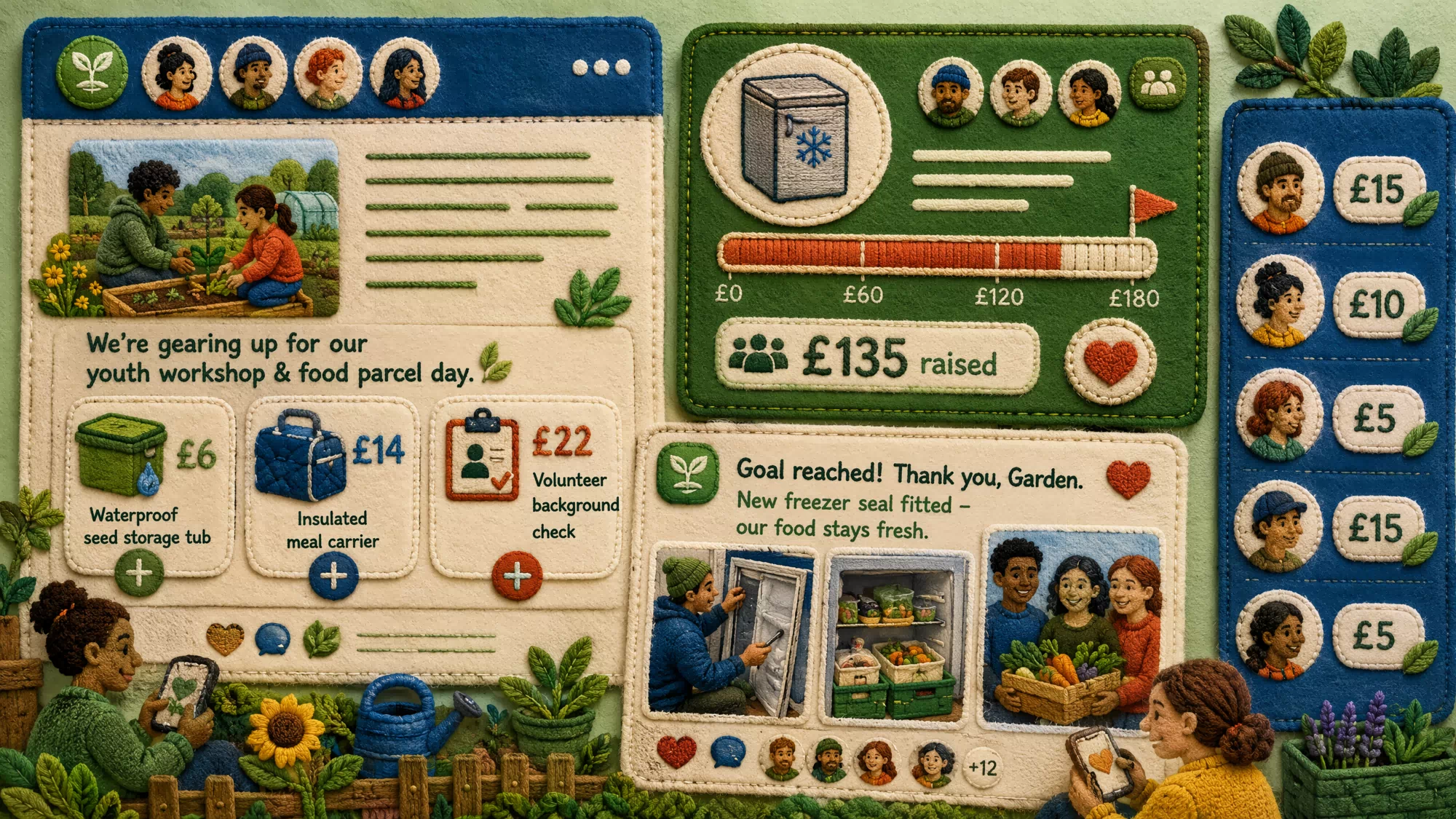
Anchor donation prompts to granular operational costs. When updating members on a youth workshop or food parcel delivery, break the needed budget into accessible amounts. A post can note that £6 covers a waterproof seed storage tub, £14 pays for an insulated meal carrier, or £22 funds a volunteer background check. Supporters readily contribute £10 when they see the exact item their gift secures.
Establish collective milestone pots for specific tasks within the Garden interface. Set up a targeted funding pool for a discrete £180 goal, such as replacing a broken freezer seal or buying timber for raised garden beds. Members watch the tally climb in real time as peers chip in £5 and £15 increments toward that visible finish line.
Tie every contribution directly to operational reporting. When a micro-target clears, publish a photo of the purchased supplies in that same thread within forty-eight hours. Visible attribution reinforces the giving habit, converting occasional contributors into steady monthly backers who fund recurring line items across your operational calendar.
Conclusion
Commercial advertising channels trap small non-profits in unsustainable bidding cycles that penalise modest budgets. Establishing an owned community on GardenOfLove protects your organisation from rising pay-per-click charges and unpredictable social algorithms. When you gather supporters around specific operational priorities, you keep direct, unmediated contact with every volunteer and donor who joins your network.
Start by launching a single Garden centred on one immediate, practical initiative. Invite twenty core volunteers, regular donors, and frontline staff to populate the first discussion threads. Post an unvarnished operational update detailing a current project need, set an initial micro-funding target under £200, and answer member feedback within forty-eight hours to establish an accountable community routine.
Frequently Asked Questions
What is community-led growth for small charities?
Community-led growth is a fundraising model that replaces one-off transactional donations with a participatory, relationship-based approach. Instead of broadcasting appeals to cold audiences, charities invite supporters into dedicated spaces to review project milestones, offer feedback, and connect with peers. This fosters a sense of ownership, transforming passive donors into active, recurring contributors who feel personally invested in the charity’s long-term mission and daily operational success.
Why do paid digital ads often fail for small UK charities?
Paid digital ads fail for many small charities because they force grassroots organisations to compete in the same auction pools as multinational charities with massive budgets. The high cost of acquiring a single donor often exceeds the value of their first gift, creating an immediate financial deficit. Furthermore, click-based donors rarely convert into long-term supporters, and social algorithms restrict unpaid reach, forcing charities to constantly pay to engage their own followers.
How can small charities effectively structure their online community spaces?
Charities should structure online spaces around specific, interest-led themes rather than a single generic board. By defining spaces based on a clear beneficiary group, a specific geographic focus, and an explicit communal task, charities create high-signal environments where members can engage in practical work. This specificity encourages meaningful discussions, such as coordinating volunteer sessions or sourcing materials, which deepens personal investment far better than general organisational updates.
What is the difference between transactional fundraising and community-led growth?
Transactional fundraising relies on a one-way exchange where a charity broadcasts an appeal, a donor sends money, and the interaction ends, typically leading to high donor churn. In contrast, community-led growth builds a two-way dialogue where supporters act as collaborative partners. This model shifts the psychology of giving from reactive, one-off payments to predictable, recurring support sustained by ongoing relationships, shared values, and direct involvement in the charity’s mission.
How can charities use micro-donations to drive recurring support?
Charities can successfully use micro-donations by linking small financial contributions directly to explicit, immediate operational costs discussed within their community. By breaking down larger project budgets into accessible, granular amounts for specific items, supporters can see exactly what their money achieves. When charities tie these contributions to transparent reporting and show the completed task within forty-eight hours, they build trust and encourage occasional contributors to become steady, monthly backers.
Why is peer advocacy more effective than paid advertising for charities?
Peer advocacy is more effective because potential donors place significantly higher trust in recommendations from colleagues, neighbours, and acquaintances than in sponsored search results. When existing community members invite peers into active project discussions, they bring in new supporters with a baseline level of trust already established. These peer-introduced donors typically stay active significantly longer than individuals acquired through commercial banner ads, making this a more sustainable long-term growth strategy.
