How Gift Aid Works: Boost Charity Impact by 25% (Without Extra Cost)
Maximising Donor Impact Through UK Gift Aid Donations
Every pound given to a registered UK charity can go further without costing you an extra penny out of pocket. Through Gift Aid, eligible organisations claim basic rate tax directly back from HM Revenue and Customs, channeling that money back into public benefit programs.
When you donate through digital fundraising platforms such as GardenOfLove, contributions of any size pair with this statutory relief. Everyday givers supply substantial additional funding to their chosen causes without touching their personal savings. Qualification requires only that your annual UK income tax or capital gains tax liability covers the total amount charities reclaim across all your gifts during that tax year.
How Gift Aid Works for Charity Donations
Under section 414 of the Income Tax Act 2007, HM Revenue and Customs treats charitable gifts as payments made net of basic rate tax. This statutory rule underpins how Gift Aid works for charity donations across the UK, allowing eligible organisations to reclaim that 20 percent basic rate tax directly from the government and convert paid tax into direct charitable funding.
Donors often wonder why the reclaimed amount equals 25 percent of their donation when the basic tax rate is 20 percent. The difference comes down to the grossing-up calculation. HMRC calculates tax relief on gross earnings before deductions occurred. Because income tax was withheld before your wages reached your account, the relief simply restores that original pre-tax sum.
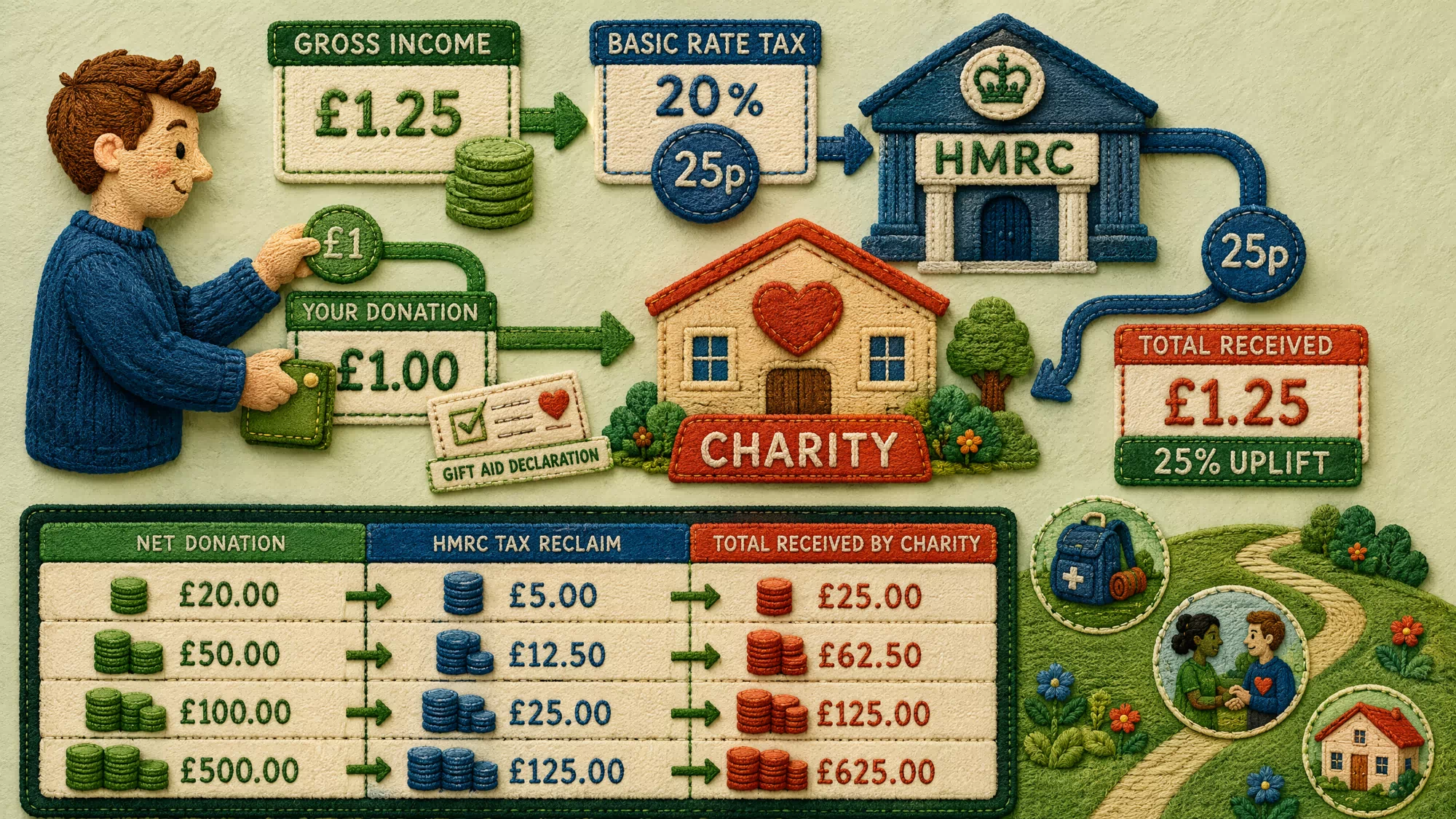
To see this in practice, consider a single gift. Suppose you earn £1.25 in gross income. HMRC deducts 20 percent basic rate tax, which equals 25 pence, leaving you with £1.00 in take-home pay. When you donate that £1.00 and provide a Gift Aid declaration, the charity reclaims the 25 pence HMRC withheld. Because 25 pence is one-fourth of £1.00, the charity secures a 25 percent uplift on your net gift. Every £1.00 you give becomes £1.25 of usable funding.
The gross-up mechanism applies proportionally across gifts of any size:
| Net Donation | HMRC Tax Reclaim | Total Received by Charity |
|---|---|---|
| £20.00 | £5.00 | £25.00 |
| £50.00 | £12.50 | £62.50 |
| £100.00 | £25.00 | £125.00 |
| £500.00 | £125.00 | £625.00 |
Charities receive these payments directly from HMRC as unrestricted funds. That extra 25 pence on every pound helps organisations cover operational overhead, secure field equipment, or expand frontline outreach without requiring another penny from your pocket.
Donor Eligibility and the UK Tax Reclaim Framework
HM Revenue and Customs sets clear rules for participating in the UK tax reclaim framework. To qualify, you must be a UK taxpayer paying either Income Tax or Capital Gains Tax during the relevant tax year, which runs from 6 April to 5 April. Across that twelve-month period, your total tax paid must equal or exceed the Gift Aid claimed on all your donations to charities and community amateur sports clubs. Taxes such as VAT and Council Tax do not count toward this total. If your aggregate tax bill falls short of the amount reclaimed, HMRC holds you personally responsible for paying the difference.
Qualifying Conditions for Basic Rate Taxpayers
Qualifying as a basic rate taxpayer begins with your annual personal allowance, currently set at £12,570. If your earnings, pension income, rental profits, or savings interest stay below this figure, you pay zero income tax. Submitting a Gift Aid declaration in that situation leaves you with an unexpected tax shortfall, unless you make chargeable asset disposals that trigger Capital Gains Tax within the same tax year.
The coverage calculation follows a simple four-to-one ratio. For every £100 you give under Gift Aid, charities claim £25 back from HMRC. To support that claim, you must have paid at least £25 in UK tax across that twelve-month period. If you give £400 across several causes over the year, charities reclaim £100 in total, which means your combined income and capital gains tax bill must reach at least £100.
Life changes such as redundancy, retirement, parental leave, or cutting back working hours can unexpectedly push your income below the taxable threshold. When that happens, HMRC leaves charity claims intact and sends a tax calculation notice directly to you for the difference. Keeping a running log of your annual donations protects you against this liability, especially if you support causes through recurring direct debits. If your personal circumstances change and you stop paying enough tax, notify each charity right away to cancel your declaration.
Charity Tax Relief for Higher and Additional Rate Donors
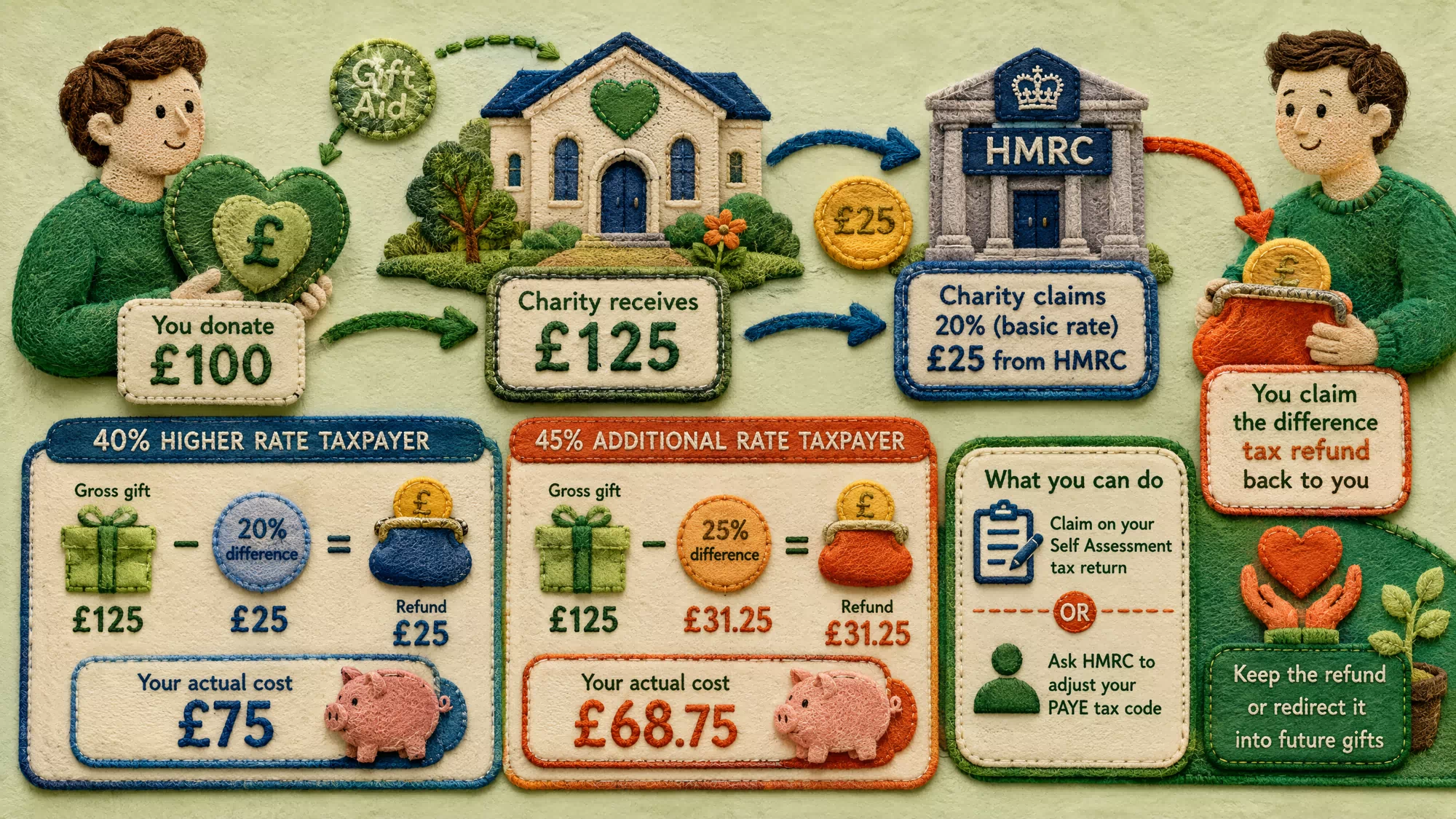
Donors in the higher or additional rate tax bands qualify for extra relief on top of what charities reclaim directly. When you give to an eligible organisation, the charity only claims the 20 percent basic rate portion. If you pay tax at the 40 percent higher rate or 45 percent additional rate, you can personally claim back the difference between your marginal tax rate and the basic rate on the gross value of your gift.
Suppose you donate £100 under Gift Aid. The charity grosses up this payment to £125 and claims £25 straight from HMRC. As a 40 percent taxpayer, you are entitled to reclaim the 20 percent difference on that £125 gross figure, giving you £25 back. You can claim this refund on your Self Assessment tax return by filling out the charitable giving section, or by asking HMRC to adjust your PAYE tax code. The charity gets £125, while your actual out-of-pocket cost drops to £75.
The same calculation applies if you pay the 45 percent additional rate. Reclaiming the 25 percent difference between the basic rate and your top bracket on a £125 gross gift returns £31.25 directly to you. That brings your effective cost for a £100 donation down to £68.75. You can keep this refund, or redirect the saved tax back into future gifts to stretch your donations even further.
Digital Giving Platforms and Automated Gift Aid Processing
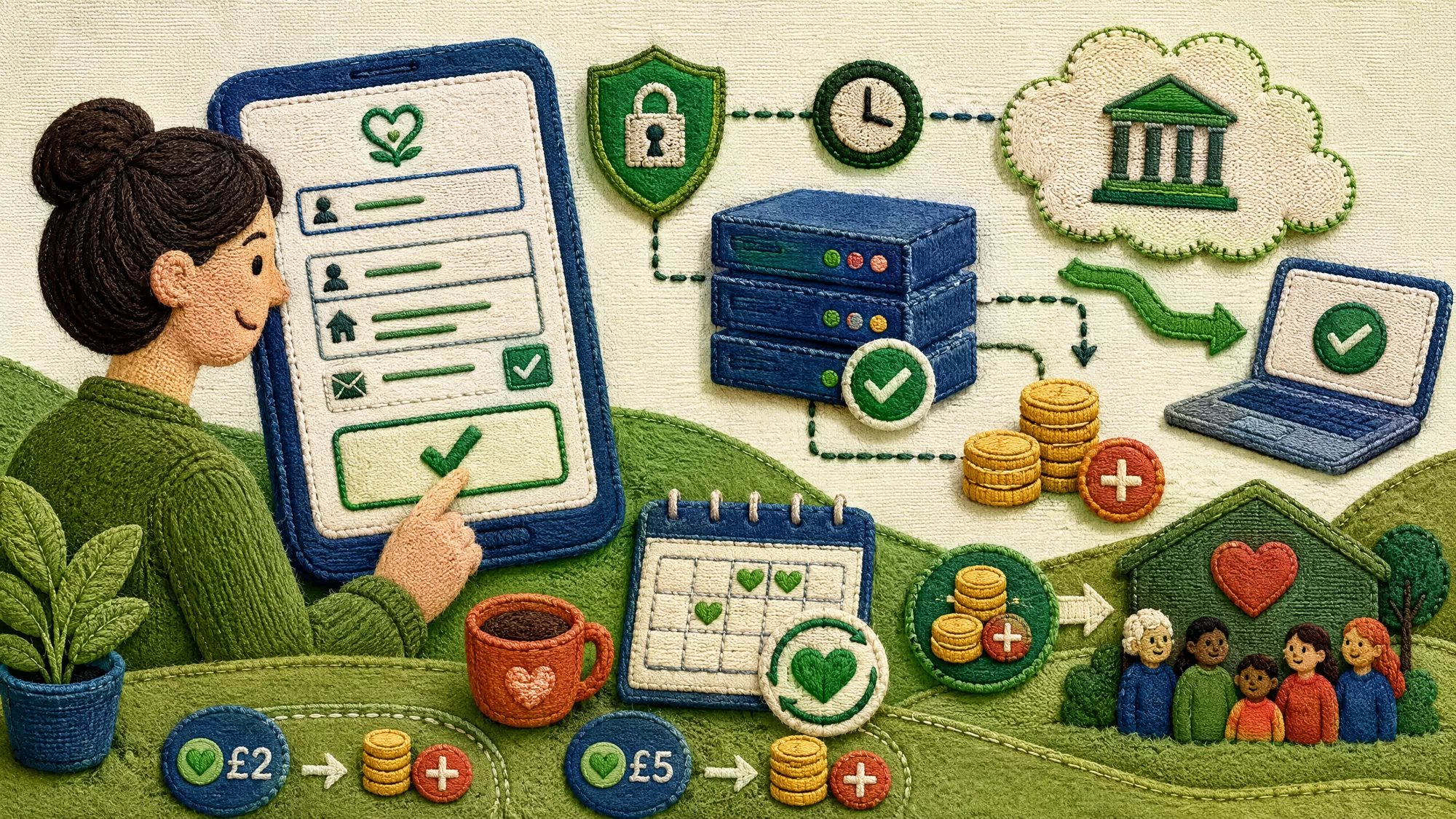
Paper declarations historically created substantial administrative friction for charities, particularly on gifts under £10. Digital giving platforms remove that hurdle by embedding statutory Gift Aid declarations directly into standard checkout flows. When donating through services such as GardenOfLove, a single tick-box confirms your taxpayer status and captures the exact donor metadata required under HMRC guidelines.
To satisfy HMRC rules, a valid declaration must record your first name, surname, full home address with postal code, and a clear statement confirming you pay enough UK tax to cover the relief. Automated platforms store these records in secure, timestamped audit trails that meet compliance standards during routine reviews. When recurring monthly gifts or sporadic micro-donations clear, the platform matches each payment against your active declaration without requiring repeated confirmations. A recurring £5 monthly gift automatically generates an extra £1.25 each month, yielding £15 in annual reclaimed relief for the charity on £60 of total giving.
Modern giving platforms also batch these contributions and submit claims straight to HMRC through digital APIs. Smaller charities often lack dedicated finance teams to reconcile paper forms against bank statements manually. Automated processing cuts out that back-office burden, routing basic rate repayments into charity accounts within weeks rather than months. Donors can give as little as £2 per transaction knowing platforms will claim the additional 50 pence without administrative deductions.
Declaration Protocols and Common Compliance Pitfalls
Gift Aid declarations fall into two distinct legal forms. A single donation declaration covers just that one gift, while an enduring declaration covers past contributions within the preceding four years as well as all future gifts to that organisation. Once set up, an enduring mandate remains valid until you explicitly revoke it.
Simple administrative mistakes frequently invalidate these claims. HMRC requires a donor’s full personal residential address, so entering a workplace address or paying with a company card automatically voids the relief. Another frequent issue arises when couples pool their giving. Because HMRC does not recognise joint declarations, the form must carry the name of the specific partner who pays sufficient income or capital gains tax to cover the claim. Most importantly, if your earnings drop below the £12,570 personal allowance, contact recipient charities immediately to cancel any enduring declarations. Failing to do so leaves you personally liable to repay HMRC for the basic rate tax claimed on your behalf.
Strategic Giving and Long-Term Philanthropic Value
Gift Aid turns everyday donations into substantial support for UK charities without adding to your household expenses. Protecting that 25 percent uplift comes down to three basic habits: tracking your contributions across the tax year, checking that your total UK tax paid covers all cumulative reclaims, and updating declarations whenever your employment status changes. Higher rate taxpayers can make their money go even further by reclaiming personal relief through Self Assessment and redirecting that refund into active campaigns. Channelling regular gifts through platforms that track declarations automatically keeps your giving fully aligned with HMRC rules year after year.
Frequently Asked Questions
What is Gift Aid and how does it work?
Gift Aid is a UK government scheme that allows registered charities to claim an extra 25 percent on donations made by eligible taxpayers. When you donate, the charity reclaims the basic rate tax you have already paid on that income from HM Revenue and Customs. This process effectively increases the value of your donation without costing you any additional money out of your own pocket.
How much extra does a charity get when I donate £100 using Gift Aid?
When you donate £100 through Gift Aid, the charity receives the full £100 from you and then claims an additional £25 from HMRC. This occurs because the donation is treated as being made net of the 20 percent basic rate tax. Consequently, the charity receives a total of £125, representing a 25 percent uplift on your original contribution, provided you have paid enough tax to cover the claim.
Who is eligible to use Gift Aid on their donations?
You are eligible for Gift Aid if you are a UK taxpayer and your annual income tax or capital gains tax payments are equal to or greater than the total amount of Gift Aid claimed by all charities you support in that tax year. Taxes like VAT or Council Tax do not count toward this total. If your tax bill falls short, you are personally responsible for paying the difference to HMRC.
Can higher rate taxpayers claim extra relief on Gift Aid donations?
Yes, higher and additional rate taxpayers can claim additional relief beyond the basic 20 percent that charities reclaim. Because you pay tax at 40 or 45 percent, you are entitled to claim the difference between your marginal tax rate and the basic rate on the gross value of your donation. You can request this refund through your annual Self Assessment tax return or by asking HMRC to adjust your PAYE tax code.
What happens to Gift Aid if my income drops below the taxable threshold?
If your income drops below the personal allowance, meaning you pay no income tax, you should immediately notify the charities you support to cancel any Gift Aid declarations. If you continue to use Gift Aid while not paying enough tax to cover the claims, you will be personally liable to pay the shortfall back to HMRC. It is crucial to monitor your tax status during events like retirement or redundancy.
How do digital platforms handle Gift Aid declarations?
Digital giving platforms simplify Gift Aid by embedding the declaration process directly into the donation checkout flow. When you tick the Gift Aid box, the platform captures your required personal details and stores them in a secure, timestamped audit trail. These platforms then use automated systems to match your donations against your active declaration and submit claims to HMRC on behalf of the charity, removing administrative burdens for smaller organisations.
Can I use a company credit card for Gift Aid donations?
No, you should not use a company card or provide a workplace address when making a Gift Aid donation. HMRC requires a valid declaration to include your full home residential address and name. Using a company card or a business address can invalidate the claim, as Gift Aid is intended for individual personal tax contributions rather than corporate giving. Always ensure you donate using personal funds to remain compliant.
